
Updated July, 2025. Sections of this text were reworded for clarity using LLMs.
Okay folks, following on from Part 2, here’s our third update of the BTC in Eureka post.
– Find part 1 here: https://edu.fair-and-squared.com/BTCBlogPart1
– Find part 2 here: https://edu.fair-and-squared.com/BTCBlogPart2
– Find part 4 here: https://edu.fair-and-squared.com/BTCBlogPart4
Find our free & paid Eureka & BTC resources here: https://edu.fair-and-squared.com/TpTFollow
We’ll wrap up this series next week with the final 4 practices from Building Thinking Classrooms by Peter Liljedahl.
Some points to note:
- After each approach is outlined, we will highlight why that practice is important and beneficial to teachers who use the Eureka curriculum.
- When you see (Liljedahl, 2019), know that I’m referencing information directly from the Building Thinking Classrooms text.
- Those who have implemented the approach, please comment with your thoughts, ideas, and resources.
- The post will take approximately 10 minutes to read. Grab a coffee and enjoy!
– We recommend watching this video to get a snapshot of a Thinking Classroom in real life:
On that note, let’s dive into the next 4 practices to develop a thinking classroom within the Eureka/EngageNY program.
Practice #7: Homework in The Thinking Classroom- From Groans to Growth
Why did the parent bring a helmet to the parent-teacher conference? Because they knew discussing homework would be a real head-banger!
Homework is a source of stress for everyone: teachers, parents, and students. Peter Liljedahl presents compelling evidence that homework has little impact on actual learning.
According to him, students need to see homework as something that benefits them, not their teacher. Once that mindset shifts, students are more likely to complete it willingly.
To support this, Liljedahl recommends not checking homework or even asking about it. Save yourself the energy, and save your students and their families the stress. Homework completion should not be your hill to die on.
At this point, I’d like to highlight how I assign homework in my class. I attribute strong MAP score growth in my class to this approach.
Here it is: Implement a flipped classroom and assign Zearn for homework. Students complete the next day’s Zearn lesson for homework the night before. This leaves them ready for the thinking task right from the get-go.
🔴 𝐖𝐡𝐲 𝐢𝐬 𝐭𝐡𝐢𝐬 𝐢𝐦𝐩𝐨𝐫𝐭𝐚𝐧𝐭 𝐟𝐨𝐫 𝐄𝐮𝐫𝐞𝐤𝐚 𝐭𝐞𝐚𝐜𝐡𝐞𝐫𝐬?
Eureka includes homework sheets with each lesson, but let’s be honest — they’re dry and rarely inspiring. In my experience, students often find the answer key online and copy it. That’s a clear sign they view homework as something to please the teacher, not to help themselves.
Zearn, on the other hand, gives students a platform they actually enjoy. It’s trackable, aligned to the lesson, and it prepares them for deeper thinking in class. I tie Zearn completion into my Classroom Economy system: students earn classroom dollars if they choose to complete it.
If you’re aiming to build a love of math in your classroom, skip the worksheet slog. Assign Zearn instead. It’ll save you class time, cut down on homework battles, and set your students up for success.
Quick tip: If your district requires written homework or you’d like to offer extra practice, try using the Eureka-aligned Spiral Review Pack. I typically use it for morning work, but it works just as well as at-home practice.
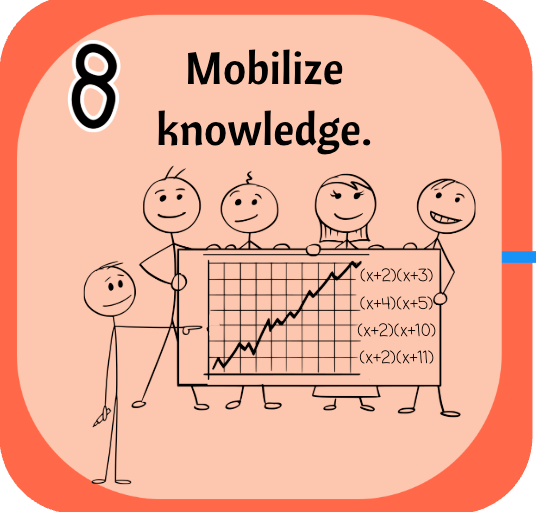
Practice #8: Mobilize Knowledge In Your Classroom- Harness The Power of Peers
Liljedahl encourages teachers to foster student autonomy by “letting go” of overly controlled instruction. We should not position ourselves as the sole source of knowledge, and we should avoid micromanaging how students engage with content.
He points out that “the amount of thinking students were required to do, and did, was sharply reduced in situations where their actions were managed- even micromanaged.” (Liljedahl, 2021).
One of the best ways to avoid micromanaging is by promoting knowledge mobilization. We introduced this concept in Part 1: students move among peer groups to see how others are approaching the thinking task. They return to their own group with new insights, and continue working collaboratively.
While this might sound like it encourages copying, I’ve found the opposite to be true. It leads to some of the most thoughtful, energized group work I’ve ever seen.
Although knowledge mobilization will often occur on its own, it helps when teachers actively direct groups to check in with others. Ask questions like, “Who else is making progress?” or “Whose board has a different strategy?” This light touch can trigger movement, fresh ideas, and deeper thinking.
* Knowledge mobilization is possibly my favorite takeaway from the BTC textbook. The best part of knowledge mobilization is that it will relieve so much of the responsibility on you as the teacher and it will energize your classroom!
🔴 𝐖𝐡𝐲 𝐢𝐬 𝐭𝐡𝐢𝐬 𝐢𝐦𝐩𝐨𝐫𝐭𝐚𝐧𝐭 𝐟𝐨𝐫 𝐄𝐮𝐫𝐞𝐤𝐚 𝐭𝐞𝐚𝐜𝐡𝐞𝐫𝐬?
The Eureka program promotes a highly structured, explicit form of learning. While explicit learning has its merit, it’s “the chili in the dish” where deep learning is the desired outcome. It’s vital to strike a balance between explicit learning and fostering implicit learning experiences in math education. Great math classrooms need both explicit teaching and opportunities for implicit learning. Implicit learning experiences, like those created through knowledge mobility, allow students to explore, discuss, and construct deeper understanding through collaboration.
The introduction of knowledge mobility to your classroom will allow for that implicit learning & deeper conceptual understanding to take place. When we mix the structure of Eureka’s explicit learning with the impliciteness (that’s probably not a real word?!) of the BTC framework, we end up with learners who not only understand mathematical processes, but also build a more meaningful understanding of why those processes work.
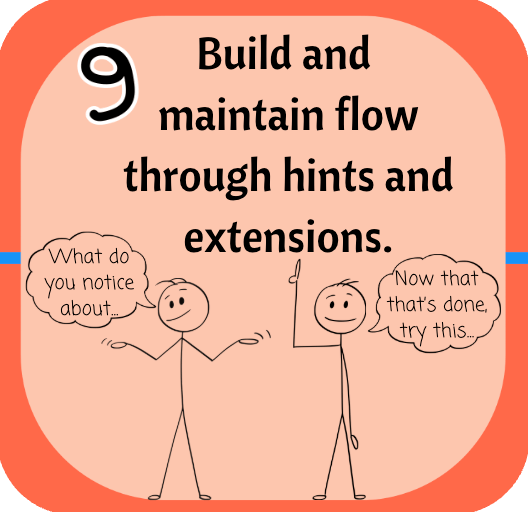
Practice #9: Using Hints & Extensions To Maintain “Flow”- The Goldilocks Zone
Liljedahl opens this chapter by emphasizing the importance of asynchronous learning in the classroom. At the same time, he acknowledges the challenge of providing differentiated learning experiences for large groups of students.
To support his point, he references the work of psychologist Mihaly Csikszentmihalyi, who introduced the concept of cognitive flow.
(Check out this video for a great explanation of what “flow” means.)
Cognitive flow is the state where a person is completely absorbed in a task. The nervous system is fully engaged, and the mind is focused without distraction. This state occurs when the level of challenge is just right- not too easy and not too overwhelming.
Because learning is at its strongest during moments of flow, it’s clear that we want our students to enter this state during math tasks.
The question is: how do we help them stay there?
According to Liljedahl, we achieve this by using hints and extensions to adjust the level of challenge as needed. This keeps students engaged, appropriately stretched, and deeply involved in their thinking.
In my classroom, here’s how this plays out in real time:
Hints: When I notice a group struggling, I offer just enough support to help them regain momentum. For example, if a group forgets to carry the one during an addition problem, I might do a quick think-aloud and walk through their process with them. The goal is for them to discover the mistake on their own. Other times, I’ll encourage knowledge mobility by directing them to check out how another group approached the problem correctly.
Extensions: This is where things get exciting. When a group finishes their thinking task ahead of others, I give them an extension that pushes their thinking further. Sometimes the extension connects to a skill we’ve already covered. Other times, it introduces a concept they’ll encounter in an upcoming lesson. Using extensions in this way has allowed us to review past learning in a more meaningful way and to preview future content with surprising success. I’m consistently amazed at what my students can do when challenged just beyond the lesson objective
🔴 𝐖𝐡𝐲 𝐢𝐬 𝐭𝐡𝐢𝐬 𝐢𝐦𝐩𝐨𝐫𝐭𝐚𝐧𝐭 𝐟𝐨𝐫 𝐄𝐮𝐫𝐞𝐤𝐚 𝐭𝐞𝐚𝐜𝐡𝐞𝐫𝐬?
As we discussed in the first post, the heart of the BTC approach is getting students to think. But when tasks are too easy, too difficult, or too dry, students check out. Eureka’s mini-lessons don’t always support that ideal state of engagement known as flow. Hints and extensions help bridge that gap. When used well, they ensure:
• Students stay engaged throughout the entire thinking task.
• Earlier concepts are revisited through active problem-solving.
• Students get a sneak peek at future learning, which builds confidence and curiosity.
One of the most powerful shifts I’ve seen is in students who come in with high math anxiety and little belief in themselves. Through consistent success with thinking tasks and extension challenges, that fear is gradually replaced by confidence. I still remember telling one student, “Guess what? You just mastered tomorrow’s lesson,” and watching their whole face light up. These moments do more than teach content, they reshape identity.
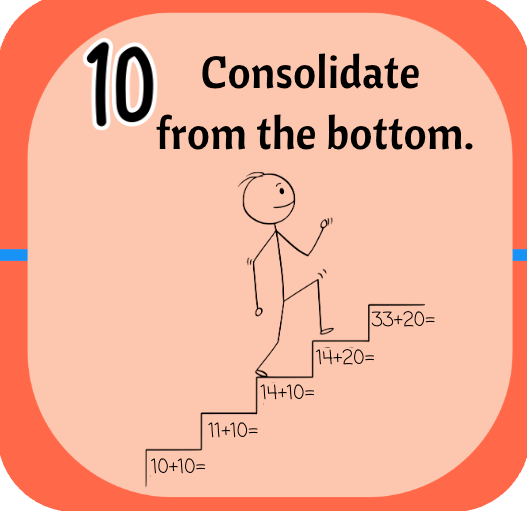
Practice #10: Consolidating Learning (The New Concept Development)- Tie it Together Explicitly
This practice is a game-changer. Say goodbye to your traditional mini-lessons and instead use a “consolidation of learning” approach. Once students complete their thinking tasks, the class gathers to review the work together. It’s during this time that you introduce the learning goal for the day.
- Show, don’t tell: Start by using student work to introduce the learning objective. Choose one group’s board and annotate directly on it using a different colored marker than what students used. Before offering any explanation, have the class discuss the group’s thinking. Ask questions like:
“What do you notice?”
“Did your group get the same answer? Why or why not?”
“What model did they use?” - Consolidate from the bottom: Begin with a group that made an error. This approach keeps higher-achieving students engaged by deepening their thinking, while also giving developing learners a place to start consolidating at their own level.
- Get moving: From there, guide the class through the work of one or two other groups, moving from less accurate to more accurate solutions. Ask students to compare, discuss, and reflect on each group’s approach. As Liljedahl notes, “the more steps, the better.” (Liljedahl, 2021)
Keep in mind the following: - While students work, keep an eye out for the groups you want to highlight during consolidation.
- Let those groups know in advance and remind them not to erase anything. Even if the work contains mistakes, students feel valued when their thinking contributes to class learning.
- Never erase student work without permission. As Liljedahl says, “Erasing devalues their work.”
- Students may still be buzzing from their thinking task. Establish clear expectations to help them stay focused and engaged during this part of the lesson.
🔴 𝐖𝐡𝐲 𝐢𝐬 𝐭𝐡𝐢𝐬 𝐢𝐦𝐩𝐨𝐫𝐭𝐚𝐧𝐭 𝐟𝐨𝐫 𝐄𝐮𝐫𝐞𝐤𝐚 𝐭𝐞𝐚𝐜𝐡𝐞𝐫𝐬?
“If all students could learn by having us just tell them how to do it, we would not have any of the problems that we have in mathematics education today.” (Liljedahl, 2021)
Students don’t want a one-way, 35-minute lecture disguised as a mini-lesson. They want to engage. Inviting them to analyze another group’s work creates far deeper understanding of the concept. As Liljedahl puts it, “Rather than explaining one’s own work, trying to decode someone else’s work changes consolidation from telling to thinking.” (Liljedahl, 2021).
The best part? Once students have attempted the task, you can often explain the Eureka learning objective in under five minutes, right on top of their own thinking. You’ll likely even have time to consolidate an extension or two.
 That brings us to the end of our post on Practices 7, 8, 9, and 10 from Building Thinking Classrooms in Mathematics by Peter Liljedahl. We hope this has sparked some fresh ideas for your classroom!
Try the Following This Week — Homework for the Teacher 😎
- Sign up for Zearn and check out the platform.
- Pick two groups and send them to see how another group approached the task.
- Use an extension task with a group that finishes early.
- Send us an email and let us know how it went! info@fair-and-squared.com
Please comment with any responses/thoughts/comments/ideas/questions!
See you soon for Part 4 of Building Thinking Classrooms In The Eureka/EngageNY Program,
The Fair and Squared Team 🌟
To check out all of our free & paid resources, find our TpT store here: https://edu.fair-and-squared.com/TpTstore



 Fair and Squared Blog Spot
2 responses to “𝐇𝐨𝐰 𝐓𝐨 𝐁𝐮𝐢𝐥𝐝 𝐓𝐡𝐢𝐧𝐤𝐢𝐧𝐠 𝐂𝐥𝐚𝐬𝐬𝐫𝐨𝐨𝐦𝐬 𝐟𝐨𝐫 𝐭𝐡𝐞 𝐄𝐮𝐫𝐞𝐤𝐚/ 𝐄𝐧𝐠𝐚𝐠𝐞𝐍𝐘 𝐩𝐫𝐨𝐠𝐫𝐚𝐦 𝐏𝐚𝐫𝐭 3 💭”
Thanks for the amazing and insightful posts on how to merge BTC and Eureka! I love how explicitly you explain your approach. I had many lightbulb moments as I read, but there is still a major challenge I don’t think I have quite figured out…You mention taking the final question in a Problem Set as your first problem for students to dive into for the day.
That is great – but here is my struggle: Eureka lessons often dictate a specific method for the math skill (a quick example is using compensation to subtract). For lessons where Eureka’s objective calls for a specific strategy/approach, how do you approach the lesson? If students are solving in an open-ended way in BTC, do you just present a subtraction problem and if students don’t use compensation, well…then what? Especially knowing the assessments are structured in a way that “forces” them to do so. Just curious how you approach this challenge in merging BTC and Eureka! Can’t wait to hear from your expertise.
One other challenge I ponder…What about using concrete manipulatives? Sometimes, especially in earlier grades, it’s important to build conceptual understanding with manipulatives, but BTC just refers to visuals and numerals. Any thoughts on lessons where manipulatives are used?
LikeLike
Hey Mr. Springs, thanks for sharing your thoughts. When it comes to “pushing” the approach that Eureka wants, I lean on a few things. First, students have usually seen similar work on Zearn the night before (See Practice #7 in the blog), which sets them up for success. Second, when I know there are multiple possible approaches, I tell students to answer the question in as many different ways as they can. Some will use the standard algorithm, but almost every group ends up using the desired approach because they saw it on Zearn the previous night. This also means that students who didn’t complete the Zearn homework are introduced to the method by their peers, creating a great peer-teaching moment and building that “thinking classroom” feel. During consolidation, I’ll often start with a group that made a mistake, move next to a group that used the standard algorithm, and finish with one that used the compensation method. This allows us to discuss the progression of the skill and opens students’ minds to the idea that math can be approached in multiple ways. If I want students to only use the desired method, I’ll be explicit and say something like, “Use the compensation method,” or “Subtract from 10 on this one.” Most students know exactly what’s being asked, and if they don’t, that’s when explicit teaching comes in. I think of it as the chili in the dish — it may not be needed all the time, but it’s essential when the desired outcome isn’t happening.
As for manipulatives, I bring them in whenever I feel the concept can be made clearer with them. Sometimes students will need to show their work both on the boards and with manipulatives, and other times I’ll drop the board work entirely and only use the hands-on tools. For example, in Grade 4 lessons on coins, I skip the board work and have them use toy coins only, while still randomizing groups and sticking to BTC principles. With long division in Grade 4, which is such a complicated concept, I have them represent the division using base-ten blocks while also recording the work on their boards. As they work, I slowly phase out the blocks so the conceptual understanding carries over to the abstract representation. I’ll link a video below that I use to model what I want the kids to do.
The main thing to remember is not to lose sight of the forest for the trees. These principles are what helped me build a thinking classroom, but they aren’t rigid rules. You’ll likely find ways to tweak them so they work best for you. The video I used to model long division was taken down, but this one is quite similar. The video I used included hundreds: https://www.youtube.com/watch?v=yQldMBmRhsA.
Hope all of that helps!
LikeLike