
Updated July, 2025. Sections of this text were reworded for clarity using LLMs.
Okay, folks, here it is- our deep dive into Building Thinking Classrooms in the Eureka/EngageNY program. This is the first of 4 blog posts on the topic.
– Find part 2 here: https://edu.fair-and-squared.com/BTCBlogPart2
– Find part 3 here: https://edu.fair-and-squared.com/BTCBlogPart3
– Find part 4 here: https://edu.fair-and-squared.com/BTCBlogPart4
Some points to note:
- After each approach is outlined, we will highlight why that practice is important and beneficial to teachers who use the Eureka curriculum.
- Those who have implemented the approach, please comment with your thoughts, ideas, and resources.
- When you see (Liljedahl, 2019), know that I’m referencing information directly from the Building Thinking Classrooms text.
- The post will take approximately 10 minutes to read. Grab a coffee and enjoy!
- We recommend watching this video to get a snapshot of a Thinking Classroom in real life.
 Liljedahl ends the book with a reminder that’s worth starting with.
The main goal of the book is to get your students thinking. It’s important to “𝘴𝘦𝘦 𝘵𝘩𝘦 𝘧𝘰𝘳𝘦𝘴𝘵 𝘧𝘰𝘳 𝘵𝘩𝘦 𝘵𝘳𝘦𝘦𝘴” (Liljedahl, 2021). The ‘forest’ is a classroom full of students who are thinking. The ‘trees’ are the 14 practices that help you get there. If your students are thinking while engaging in math, you’ve already succeeded. Don’t get too caught up in doing everything perfectly. The goal is thought, not perfection.
 𝐖𝐡𝐲 𝐢𝐬 𝐭𝐡𝐢𝐬 𝐢𝐦𝐩𝐨𝐫𝐭𝐚𝐧𝐭 𝐟𝐨𝐫 𝐄𝐮𝐫𝐞𝐤𝐚 𝐭𝐞𝐚𝐜𝐡𝐞𝐫𝐬?
In many classrooms, Eureka lessons can lead students to mimic the teacher’s steps without truly thinking.
“Thinking is a necessary precursor to learning.” (Liljedahl, 2021).
To benefit from programs like Eureka, we need to foster a thinking environment that also encourages students to deepen their understanding of the concepts explored without simply mimicking procedures.
On that note, let’s dive into the first practice to develop a thinking classroom.
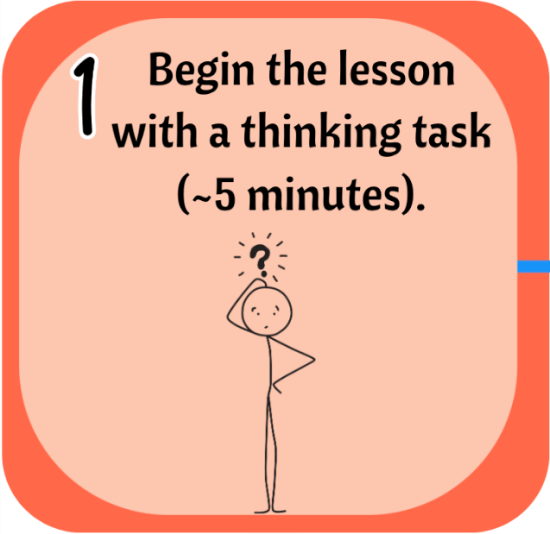
Practice #1: Ditch the Mini-Lesson: How Thinking Tasks Elevate Your Eureka Classroom
I ditched my mini-lessons and introduced “thinking tasks” to my students instead.
Liljedahl breaks the tasks that we should give to our students into these 2 categories.
– Non-curricular thinking tasks
– Curricular thinking tasks
𝐍𝐨𝐧-𝐜𝐮𝐫𝐫𝐢𝐜𝐮𝐥𝐚𝐫 𝐭𝐚𝐬𝐤𝐬 are simply tasks that promote problem-solving & thinking among your students. These are often known as Low-Floor, High-Ceiling tasks. They are not tied to the content that you’re studying, and their main goal is to get your students into the mindset that theirs is a thinking classroom, where ideas are valued more than right answers.
- Non-curricular tasks have many access points and can be explained in a variety of ways. Here is an example of a non-curricular thinking task: “If I were to write the numbers from 1 to 100, how many times would I use the digit 7? What if I wrote 1 to 1000? How many zeros?” (Liljedahl, 2021).
Liljedahl says that using 3-5 of these non-curricular tasks is enough to shift your students’ mindset from “mimickers” to problem-solvers.
Check out these great sources for thinking tasks:
• Inside Mathematics – Problem Solving
• YouCubed
• NRIC
• The Ontorio-Montclair District webpage
After completing 3-5 of these tasks with your students, substitute the non-curricular tasks for 𝐜𝐮𝐫𝐫𝐢𝐜𝐮𝐥𝐚𝐫 𝐭𝐚𝐬𝐤𝐬.
𝐂𝐮𝐫𝐫𝐢𝐜𝐮𝐥𝐚𝐫 𝐭𝐚𝐬𝐤𝐬 are tasks that are aligned with the Eureka program. I give my students the last question from their Problem Sets. This way, they have answered the most difficult question that they will encounter later as they work independently.
A key point that we will cover in the next post is the importance of giving the task within the first 5 minutes of the lesson. That means if you have to pre-teach a new concept, you should aim to do it in under 5 minutes. In a nutshell, student attention drops off rapidly after 5 minutes. Always reinforce the idea to students that they are thinkers in a thinking classroom. 𝐖𝐡𝐲 𝐢𝐬 𝐭𝐡𝐢𝐬 𝐢𝐦𝐩𝐨𝐫𝐭𝐚𝐧𝐭 𝐟𝐨𝐫 𝐄𝐮𝐫𝐞𝐤𝐚 𝐭𝐞𝐚𝐜𝐡𝐞𝐫𝐬?
Starting with curricular thinking tasks, even before modeling, helps students become self-reliant problem-solvers in mathematics. It’s far more engaging than simply showing them how to do it. Students don’t want everything handed to them. They want a chance to figure it out! That doesn’t mean we skip modeling; it just comes after they’ve had a go. The result? Deeper understanding and way more buy-in. (More on this in next week’s post!)
Practice #2: Mixing It Up – How Random Groups Fuel Eureka Math Moments
This step is profound and has had a huge impact on collaboration & social interaction in my classroom, leading to happier learners!
Peter Liljedahl recommends pairing students in Grades K-2 and forming groups of 3 for Grades 3 and up. Trust him on this. Three is the magic number. In groups of four, someone’s always on the edge, doodling a dragon or distracting other group members.
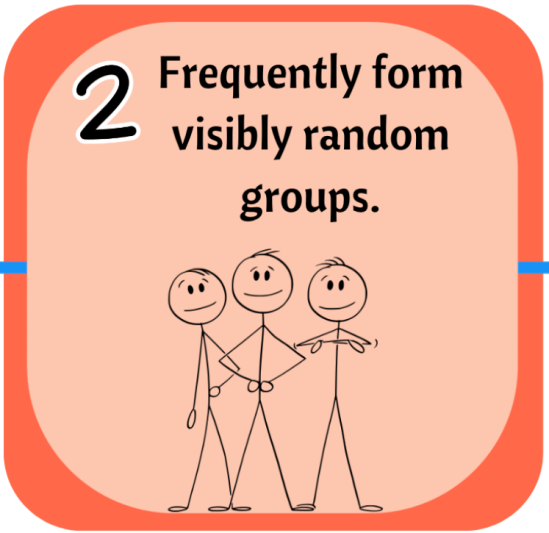
Make sure that you randomly select these groups and that the random selection is visible to students. I use lollipop sticks- they’re fast and build suspense. Each group only gets one marker to work with. This is important as it forces collaboration- no marker hoggers!
Students may be resistant in the first week to work with their group, but “that resistance is usually completely gone at the three-week point.” (Liljedahl, 2021). My students love getting assigned random groups & their ability to collaborate in randomized groups has been astounding. This increased socialization with peers they wouldn’t normally converse with is a big part of why students grow to love math under this framework. Remind your students to collaborate well (more on how we can measure this in a future post), and encourage them to pass the marker frequently.
In this chapter, Liljedahl also introduces another concept that I love. It’s called “knowledge mobility.” It’s the idea that knowledge and ideas for task completion will move around the classroom from group to group. It’s not cheating or copying.
Students often walk over to other groups to get hints or ideas that help them move forward. They might compare answers or strategies. When a group gets stuck, I usually encourage them to check out another group’s work to help them get back on track.
This kind of knowledge mobility shifts your role in the classroom. Instead of being the one with all the answers, you become a facilitator who supports students as they work through the task themselves. It also gives you the chance to step back and really observe the learning as it happens. More on knowledge mobility in blog post #3.
𝐖𝐡𝐲 𝐢𝐬 𝐭𝐡𝐢𝐬 𝐢𝐦𝐩𝐨𝐫𝐭𝐚𝐧𝐭 𝐟𝐨𝐫 𝐄𝐮𝐫𝐞𝐤𝐚 𝐭𝐞𝐚𝐜𝐡𝐞𝐫𝐬?
Eureka Math is a highly explicit program where students often work independently and the teacher provides most of the instruction. By introducing randomized grouping, along with Practice #3, you’ll increase student engagement and bring more social interaction into your classroom. It also helps create a more positive learning environment and frees up your time to focus on intervention. I even apply this approach to Problem Sets by having students check each other’s answers once they’ve finished!
This shifts the responsibility for learning to the students, giving you space to check in with those who need support, or to sneak in that last heroic sip of lukewarm coffee. 😉

Practice #3: Use Vertical Non-Permanent Surfaces to Bring Group Thinking to Life
This one is a big shift, and it makes a huge impact. Liljedahl promotes the use of vertical whiteboards when completing thinking tasks. I said whiteboards, but any board where you can easily erase the writing works well. I use the 2 whiteboards & windows in my class. I’ve even used the doors when we were short on space. Imagine the excitement that this generates for students.
Liljedahl encourages using VNPSs for the following reasons:
- They get students to task faster
- Student work can more easily be erased, making learners feel safer to take risks & make mistakes
- They improve collaboration
- They heighten knowledge mobility between groups
- Standing improves mood & gives a larger canvas for non-verbal communication between group members
- When sitting, students can make themselves anonymous more easily
- Teachers and learners can see student thinking.
- When time is up on the task, the teacher can choose work from the students and annotate it using a different colored marker to consolidate what was learned. This is my new mini-lesson. It is during this time that I highlight what the students did well and share what the learning goal of the day was. More on this in blog post #3!
𝐖𝐡𝐲 𝐢𝐬 𝐭𝐡𝐢𝐬 𝐢𝐦𝐩𝐨𝐫𝐭𝐚𝐧𝐭 𝐟𝐨𝐫 𝐄𝐮𝐫𝐞𝐤𝐚 𝐭𝐞𝐚𝐜𝐡𝐞𝐫𝐬?
When students stand to work, it brings back the energy that’s often missing in traditional math lessons. You’ll feel the buzz as students communicate and work through problems together. It’s a complete shift from passive learning to active engagement. As I said, I give the last Problem Set question as my curricular thinking task and students LOVE IT! Before, students were sitting on the carpet while I talked them through the solution. BORING!!
Get them on their feet and talking. It’s a simple shift with big results.
 That wraps up our post on practices 1, 2, and 3 from “Building Thinking Classrooms in Mathematics” by Peter Liljedahl. Thank you for reading and we hope that this post has inspired some ideas for you!
Try the Following This Week- Homework for the Teacher 😛
1. Begin one lesson with a non-curricular thinking task instead of a mini-lesson to kickstart problem-solving.
2. Randomly assign students to visible groups of two or three and give each group one marker to promote collaboration.
3. Have students complete their thinking task on a vertical surface like a whiteboard, window, or door.
4. Send us an email and tell us how it went! info@fair-and-squared.com
See you soon for Part 2 of Building Thinking Classrooms In The Eureka/EngageNY Program,
The Fair and Squared Team 🌟
To check out all of our free & paid resources, find our TpT store here: https://edu.fair-and-squared.com/TpTstore
 Fair and Squared Blog Spot